


Ébène Quartet Thrills with Breathtaking Mozart, Debussy, and Brahms

Sunday, April 12, 2026
Capital Region Classical, Union College Memorial Chapel, Schenectady, New York
Quatuor Ébène
Pierre Colombet, violin
Gabriel Le Magadure, violin
Hélène Clément*, viola
Yuya Okamoto, cello
(*substituting for Marie Chilemme)
W. A. Mozart, Quartet in D Minor, K. 421 (1783)
Allegro moderato
Andante
Menuetto and Trio -- Allegretto
Allegretto ma non troppo – Più allegro
Claude Debussy, Quartet in G Minor, Op. 10 (1893)
Animé et très décidé
Assez vif et bien rythmé
Andantino, doucement expressif
Très modéré-Très mouvementé et avec passion
Johannes Brahms, Quartet in A Minor, Op. 51, No. 2 (1873)
Allegro non troppo
Andante moderato
Quasi Minuetto, moderato -- Allegretto vivace
Finale. Allegro non assai
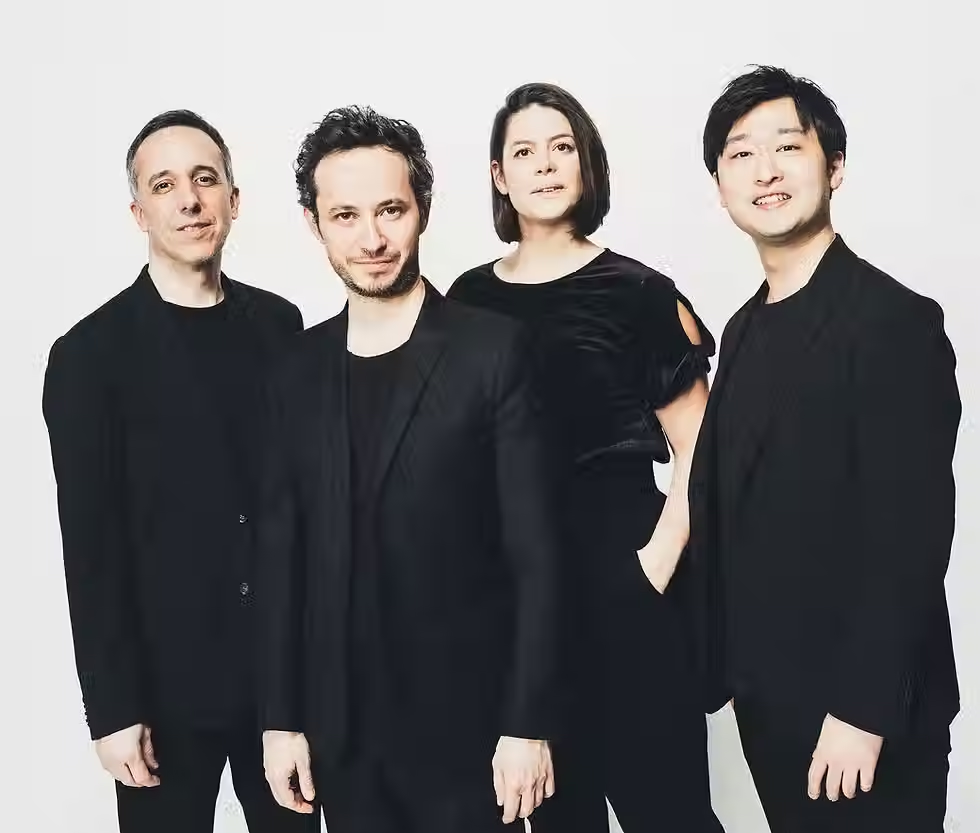

Ébène Quartet Thrills with Breathtaking Mozart, Debussy, and Brahms
It’s a feast of riches, almost too good to be true: both Ébène Quartet and Belcea Quartet, perhaps the two preeminent string quartet ensembles today, appear regularly at Union College, under the auspices of Capital Region Classical. This past October, I attended the Belcea Quartet recital, and was saddened to hear this group would not be appearing in the upcoming season. In this concert, Quatuor Ébène delivered an astonishing afternoon, demonstrating that even the most revered classical works can yield new landscapes of expression and meaning. While Ébène can be said to perform with non plus ultra panache, today’s recital reaffirmed their instinct for innovative musical insight, marked by meticulous attention to detail, and a unifying, visionary interpretation. I have felt these same sensibilities in Belcea Quartet’s appearances here, though they might be said, at times, to privilege technical flair over inner lyricism. However, I don’t recall a more vital quartet recital, nor a more ecstatic audience response than this.
Mozart’s K. 421 is one of the composer’s famed quartets dedicated to his teacher, Joseph Haydn. It opens with a heart-wrenching movement in the usual sonata form, and concludes with a melancholic set of variations on a wistful theme. One might imagine this movement to have inspired Franz Schubert years later. The D minor mood pervades the entire work, and Mozart experiments with thematic phrasing, formal design, and the use of dissonance. The first movement, both intense and affirming, contrasts with the dramatic second movement, an ABA form that frames wrenching lyricism within poetic edifices. His wife, Constanze, said that the shape of the rising thematic motif was inspired by her cries in labor with their first child. By the time we get to the minuet and theme and variations finale, Mozart dispenses some gutsy and sinewy dissonance, especially at the very end: perhaps the cries of his newborn son in the next room.
Debussy’s G minor quartet, now a standard in the quartet canon, had many surprises. Two years ago, Belcea performed this quartet emphasizing the lyricism and counterpoint in a completely impactful way. Ébène’s vision shunned any blurry impressionist reticence or delicate limning of Gallic pastels. Instead, an inevitable dramatic arch was carefully crafted with each movement, lending purpose and momentum to the climax at the end.
Perhaps the most compelling interpretation was in the second movement, Assez vif et bien rythmé, a scherzo. Yes, the unison pizzicatos were certainly rhythmic and harp like, but rather boastful, loud, and even a bit martial. The third movement, an enchantment of sonorities, gave each soloist a thematic prominence, with and without mutes. Pierre Colombet’s soaring descant was unforgettable. Violist Hélène Clément (who substituted for Marie Chilemme) deserves kudos for the magical opening in the center C# minor section. The solemn accompaniment and whispering chords owed much to the cello (Yuya Okamoto) and second violin (Gabriel Le Magadure). Mr. Colombet’s tricky plaint in parallel octaves was perfect preparation for the final passages. In the fourth movement, Debussy echoes moments of Parsifal with his own sleek harmonic language. The climax was planned all along. Fragile inner voice details that do not come out in many performances were raised on a crest of great passion here; the turbulent ensemble interplay, like a boat on roiling waters, was thrilling.
While the Debussy had its roots in the late romantic idiom, Brahms’ Quartet in A minor Op. 51, No. 2, enjoyed being on the fringe of a latter-day dreamscape throughout the first two movements. This piece is certainly rigorously formal, as is Brahms’ wont, but texturally and harmonically in search of the new age. Schoenberg notably praised the modernity in this quartet. Brahms labored some four years gestating his two Op. 51 quartets. As consolation, he noted that even a prodigy like Mozart took inordinate trouble and time writing his magnificent quartets dedicated to Haydn. Brahms further admitted, of course, the specter of Beethoven’s monumental quartets was a psychological burden.
This A minor quartet is unusually invariant in that all movements are in the key of A with three minor mode movements and one major mode movement. This homotonality makes for a feeling of unification throughout. Such tonal statis between movements harkens back to the Baroque era, and, not surprisingly, Brahms infuses the quartet with contrapuntal artistry a la Bach. Mozart used canons in his Haydn quartets, and Brahms didn’t hold back in showing off his skill in using imitation and canon throughout. In the first movement, for example, the texture and rhythmic swing are quite elastic: much of the melodic interplay is quasi-canonic with occasional displays of elongation and inversion.
Brahms also dabbles in “tones as letters” to spell a phrase, a technique known as Tonbuchstabenmotiven–-sound-letter motifs. Bach practiced this most famously with his name Bb-A-C-H (H being B-natural in the German-speaking world). The Brahms quartet opens with the motif F-A-E referencing Joseph Joachim’s motto “Frei aber einsam” and transmuting it to F-Ab-F as “Frei aber Froh.” These compositional devices and references produce an overwhelmingly imaginative and dense opening movement. The second movement offers a seeming contrast in A major with a gentle song. However, rhythmic and harmonic turbulence brings rapid minor key changes (C# minor-F major-D minor). Here, in the middle section, Brahms treats us to one of his more overt canons with widely spaced voices. The dreamlike sound of the Quasi Minuetto is informed by the plaintive gypsy-like melody over an open fifth drone in the lower strings. This mysterious section encloses an agitated passage that suggests canonic motion, but ultimately functions as a foil to the pensive, modal outer sections.
Brahms unleashes a marvelous Hungarian folk dance, a czárdás, for the finale which ushers in his idiomatic duple-triple meter interplay (hemiola) and striking sequences of dominants. The last movement’s middle section yet again imparts canonic lines, and a wildly fast coda allowed Ébène Quartet to give a perfect theatrical punch that brought an immediate ovation of cheers.

Comments